
Impact
Theory of change
Carbon Bank's theory of change starts from the principle that degraded land will only remain productive when local communities have a recurring economic reason to maintain it.
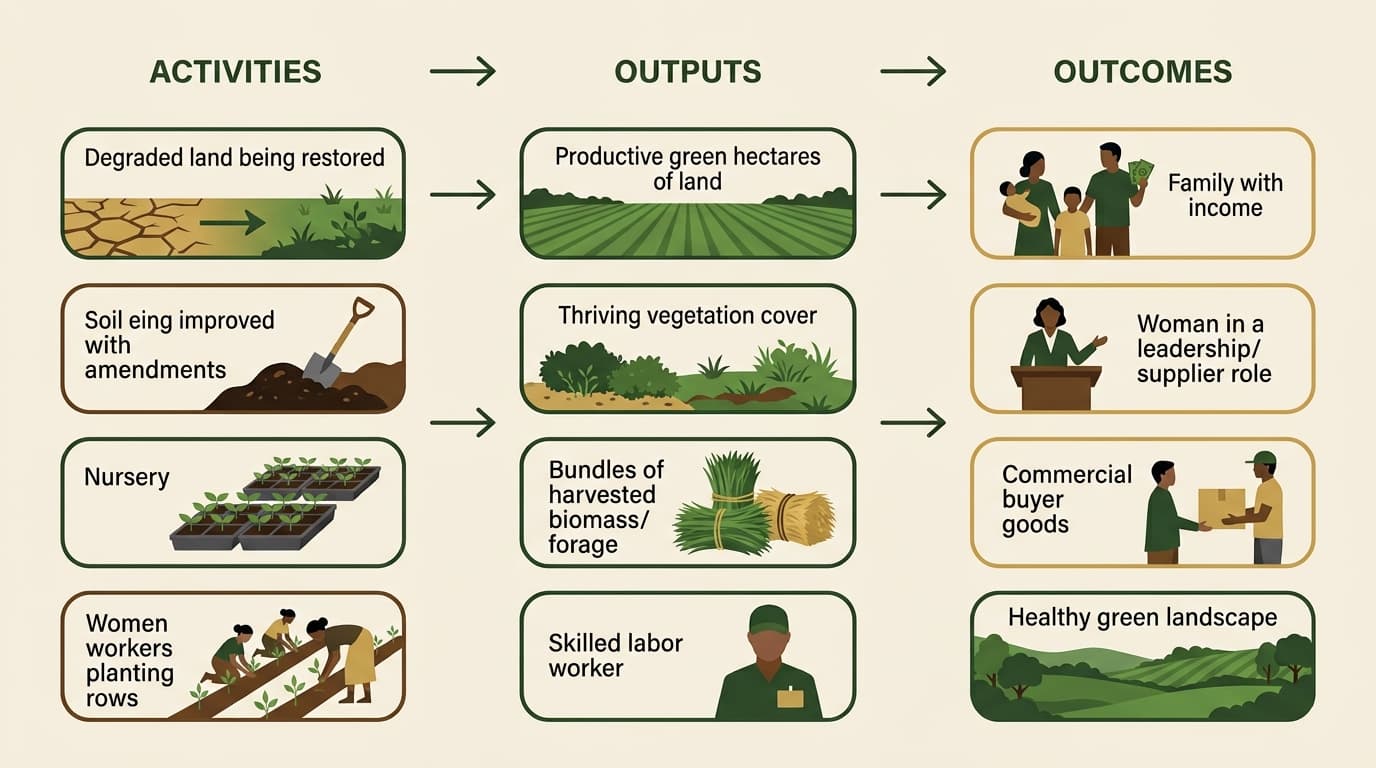
The model in detail
Activities, outputs, outcomes
Activities
What Carbon Bank doesRehabilitate degraded and underutilised land
Improve soil condition
Establish nurseries and regenerative forage systems
Organise rural women and local workers into paid roles in planting, land stewardship, harvesting, primary processing and local supply
Outputs
What activities deliverProductive hectares
Improved vegetation
Viable planting materials
Marketable biomass
Paid workdays
Trained workers
Recurring buyer relationships
Short-term outcomes
What beneficiaries achieveWomen and low-income rural households gain practical skills
Additional income for rural families
Access to commercial agricultural supply chains
Continued land maintenance and expansion beyond the grant period
Measurement
KPIs we track
We monitor performance across land restoration, soil health, biomass production, worker activation and recurring commercial sales.
Hectares rehabilitated and productively managed
Target: 20 ha
Status: current
Land and warehouse workers in paid roles
Status: current
B2B transactions completed
Status: current
Low-income rural women activated (2-year target)
Status: target
Soil pH improvement (baseline to target)
Target: neutral range (6.0–7.0) pH
Target: neutral range (6.0–7.0)
Status: baseline
Planting survival rate
Status: target
Nursery seedling output (monthly)
Status: tracking
FY2025 operating revenue
Status: current
Long-term impact
A replicable model in which degraded land becomes a productive environmental and economic asset, women participate in higher-value rural work, and agricultural and livestock businesses gain more reliable access to locally produced biomass.